

Crypto Airdrops: Free Money, Real Risk
Last Updated on: November 21, 2026The word airdrop conjures images of cargo planes dropping supplies to people waiting below.
In crypto, it’s something else entirely… free coins dropped into your wallet, usually as a marketing play by a new project… that’s the appeal & the trap in the same sentence.
Getting free money is fun… getting drained by a malicious approval dressed up as free money is not.
Let’s walk through how airdrops actually work, where the risk sits, and how to tell a real one from a lure.
What an Airdrop Actually Is
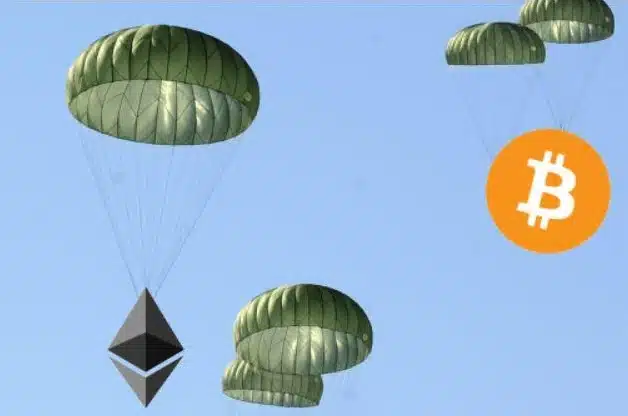
An airdrop is free coins or tokens sent to a wallet.
Projects use them to build followers and enthusiasm, and they factor the distribution into their total token supply before launch.
The lure of free crypto is enough to get a lot of people interested… particularly those building multiple streams of passive income.
It’s a legitimate marketing strategy, and it’s also one of the cheapest customer acquisition tools in the space.
The Airdrop Marketing Funnel
Every airdrop is different, but the qualification requirements follow a pattern, and the pattern is the point.
Most require some form of KYC… even the laziest ones want a name, an email, and a wallet address… which hands the project an email list of interested people to market to for years afterward.
Step one complete.
From there, requirements escalate to social sharing… post the airdrop on Facebook, Twitter, Instagram, wherever.
The average person’s social footprint is around 300 contacts… so every registrant exposes the drop to hundreds of new eyeballs.
Step two complete.
Some projects sweeten it with referral bonuses… paying a percentage of tokens to whoever brings in the most people… then the whole sequence repeats for every new registrant.
Step three complete.
That’s virality, engineered.
A Brief History
The first recorded airdrop came from Auroracoin in March 2014, which distributed roughly 50% of its total supply to Icelandic citizens as a response to the 2008 economic crisis… it was a fresh idea and it worked as a spectacle.
Airdrop Alert, the first site dedicated to listing them, is somehow still running today… a genuine achievement in a space where most things die inside a year.
What Changed Since Then
The 2019 version of this article would have described social-share farming and stopped… the model has moved on.
Projects now run sybil filters to flag farming behavior… and getting flagged costs you the allocation… claim windows expire, and missing one costs you too.
Drops are increasingly targeted at on-chain behavior rather than retweets.
And do you want some brutal honesty?
Well here it is… 88% of airdropped tokens decline in value within 3 months, because recipients dump them the moment they land.

Where the Scams Hide
Airdrops are one of the most common attack vectors in the space… they get the wallet owner to generate wallet-draining approvals.
The pattern is consistent…
A token appears in your wallet you never asked for… you visit a site to “claim” more… you sign an approval… and the contract gets permission to move everything you hold.
The defense?
It’s boring but effective.
- Use a dedicated wallet for airdrops and keep minimal balance in it
- Never approve unlimited spending from your main wallet
- Revoke permissions regularly
- And confirm any drop against the project’s official channels and community forums before you touch a link
Using listing sites like Airdrop Alert, Airdrops.io, and Crypto Airdrops are useful starting points, not verification.
The Tax Question
Receiving an airdrop is a taxable event in most jurisdictions… valued at market price on the day you receive it.
That’s generally true whether or not you sold anything… and it’s true whether or not the token was worth anything a week later.
Keep a record of the date and the price at receipt… your future self will thank you.
Tracking cost basis across wallets is a nightmare without help, I use & recommend Koinly.
The Honest Ledger
The upside for a recipient is real.
Airdrops cost a project almost nothing relative to paid acquisition, they build loyalty among early users, and they can put genuinely valuable tokens in your hands for a few minutes of work.
The downside for the recipient is real too.
Scams are everywhere, pump-and-dump dynamics are baked into the model, and there’s a developer-side cost the promotional version never mentions… handing tokens to people who only want the flip destabilizes your price and pollutes your product-market fit signals with users who never intended to stick around.
But ultimately, airdrops are a useful tool for projects and a genuine opportunity for participants, but “free” is doing a lot of work in that sentence.
The work is real… the tax is real… and the risk is concentrated in the moment you sign an approval… treat every drop as a stranger handing you something on the street… say thank you, check where it came from & don’t hand over your keys until you’re satisfied.
Investigate the project before you spend your time or your information, and keep the wallet you claim with separate from the wallet you care about.


