
The Privacy Paradox of Brave Browser & The BAT Ecosystem
Last Updated on: November 14, 2026Are you tired of feeling like you’re the product?
Every click… every search… and every site you visit is tracked, logged, and sold to the highest bidder.
This is the reality of the modern web, a system designed to profit from your attention.
Brave Browser emerged as a revolutionary answer to this problem, promising a “privacy by default” internet.
But as its ecosystem has evolved, a critical question remains… does it deliver true digital freedom, or does it simply offer a more comfortable cage?
Originally published in 2019… this article has been updated for 2026 to give you a clear, no-nonsense analysis.
Brave’s Core Promise
At its heart, Brave is a privacy tool… this is why I have exclusively used Brave since it came out… I like the functionality… the privacy… and the mission.
Brave’s primary function is to stop the constant surveillance that plagues other browsers… it accomplishes this with its signature “Shields Up” feature, which is activated by default.
This isn’t just an ad-blocker… it’s a comprehensive security suite that blocks cross-site trackers… fingerprinting scripts… and invasive cookies.
By preventing these resource-heavy scripts from loading, Brave delivers on its secondary promises… web pages load noticeably faster… your data usage drops… and your device’s battery lasts longer.
The need for more privacy in a web browser has become increasingly important since I originally penned this article…
A privacy browser is just the first step in your online privacy… explore ways to better increase your security online here.
Over the last few years we’ve seen other browsers like Firefox improve their privacy protections… but Brave remains the most aggressive by default… making it the ideal “set it and forget it” solution.
Brave In Action
As I mentioned previously, I was drawn to Brave because of it’s promise of privacy… but when I saw this video featuring Brenden Eich… and realized Brave was based on Chromium… I was sold.
Why?
Honestly, I wasn’t interested in trying to learn a “clunky” web browser…
But then I used Brave, and I’ve been experiencing the benefits every day since…
One of the most satisfying parts of my day is opening a news site and watching the Shields icon show me that it’s blocked over 50 trackers and ads before the page has even fully loaded.
The result is a clean, uncluttered page that focuses on the content… not the pop-ups.
This is most apparent on platforms like YouTube… in Brave, you get the video and nothing else… no pre-roll ads… no banner ads… no distracting pop-ups asking you to subscribe… it’s a pure, focused experience.
On mobile, this translates to real-world benefits… my pages load faster… and because the browser isn’t working overtime to run tracking scripts, my phone’s battery lasts noticeably longer.
This isn’t just about privacy… it’s also about performance.
BAT Ecosystem: A Privacy Paradox
Here is where things get complicated… Brave offers more than just privacy… it offers an ecosystem powered by its Basic Attention Token (BAT).
The concept is brilliant… as a matter of fact, it was one of the main reasons I settled on Brave… you can voluntarily opt-in to view privacy-respecting ads and get paid for your attention.
This creates a system where advertisers get a better ROI and users get a piece of the pie.
It sounds like a true win-win… however, this system introduces a central paradox.
To participate, you are voluntarily re-entering the world of digital advertising you were trying to escape… more importantly, to actually withdraw and use the BAT you’ve earned, you must connect your in-browser wallet to a third-party custodian, like Uphold.
This requires completing Know Your Customer (KYC) verification, handing over your personal identification to a centralized company.
This is the fundamental conflict… to claim your earnings from a privacy-focused browser, you must sacrifice a layer of your privacy.
Frankly, as I’ve come to realize that this idea will only become powerful when it is able to be utilized in a completely decentralized manner.
Let’s be clear about this trade-off…
The process of connecting your Brave Rewards to an exchange like Uphold is a direct contradiction of the browser’s core ethos… you’re trading your anonymity for the ability to access a few dollars worth of a volatile token.
For many… myself included… who are serious about self-sovereignty, this is a non-starter.
It’s a deal-breaker that turns a tool of liberation into just another system that requires you to play by centralized rules.
While the browser itself keeps your browsing data private… the financial side of its ecosystem pulls you back into the very system of dependency and surveillance that Brave was designed to fight.
This isn’t to say the system is malicious at all… but it is a compromise you must be aware of.
Brave for Content Creators
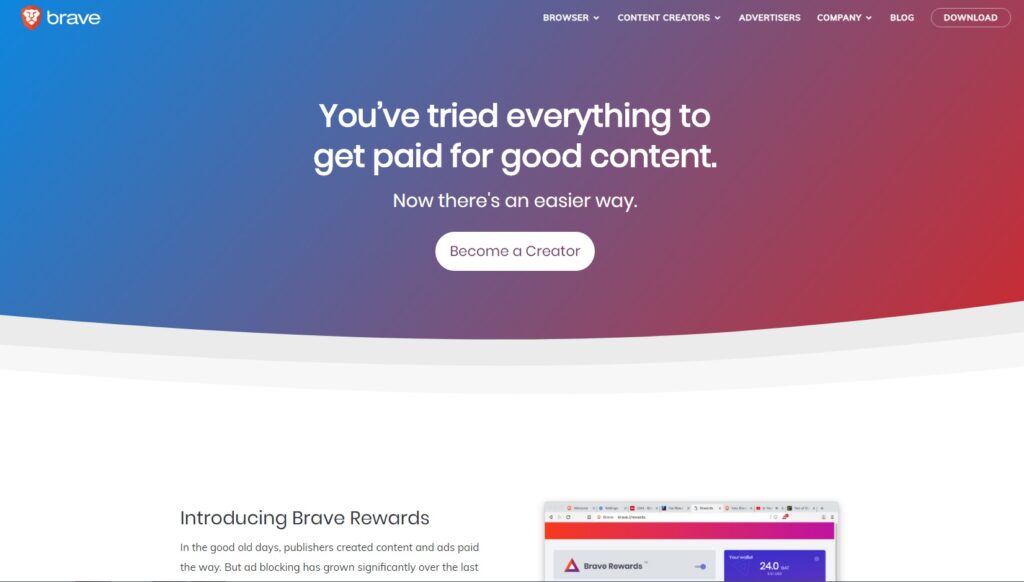
For those who create content (you’ll find CCM as a certified Brave content creator), Brave offers a way to be rewarded directly by their audience.
Readers can tip BAT to creators they value, and users can enable an “Auto-Contribute” feature that distributes a monthly BAT budget to the sites they visit most… this is a powerful idea that cuts out platform middlemen.
In practice however… it remains a niche benefit.
For most creators, the income generated from these tips is a small, unpredictable supplement, not a viable replacement for other revenue streams.
It’s a “nice-to-have” that demonstrates the potential of a new creator economy… but it has not yet become a primary driver of income for the vast majority of online creators.
Tool vs. Trade-Off
So, is Brave Browser the privacy savior we’ve been waiting for?
The answer is nuanced…
As a secure, private, and fast web browser, Brave is one of the best options available in today… it’s a massive upgrade over mainstream browsers and an essential tool for anyone looking to take back control of their web experience.
However, its BAT rewards system is a complicated experiment with a significant trade-off.
My take… use Brave for its core privacy features without hesitation… but when it comes to the rewards, understand that you are making a choice between convenience and true self-sovereignty.
Looking ahead… the big question for Brave is whether they can solve the custodian problem… will we one day see a truly decentralized, non-custodial way to withdraw BAT?
And how will they continue to compete as other browsers like Firefox and Arc continue to innovate on privacy?
The future of Brave depends on closing the gap between its privacy-first browser and its centralized rewards system.