What The CLARITY Act REALLY Means For Your Yield, DeFi & Financial Sovereignty
Last updated on March 30th, 2026 at 01:17 pm
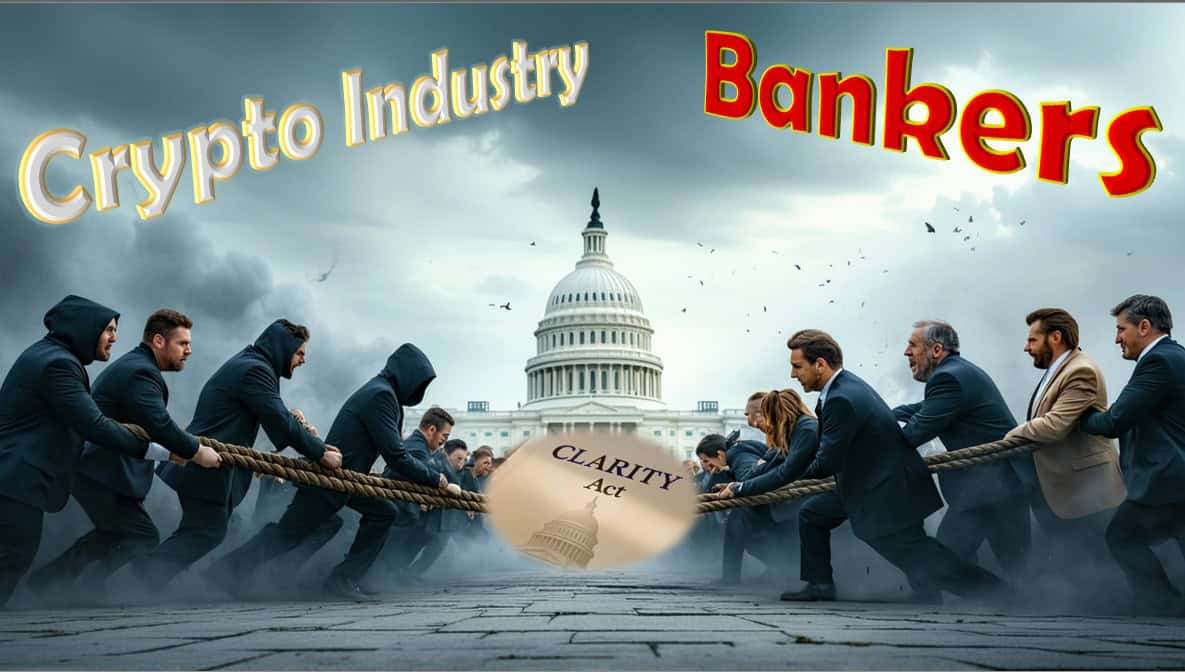
Unless you’ve been living under a rock over the past several months… the fight… errr, I mean debate, over the CLARITY Act has been raging fast and furious throughout DC and the crypto space.
The latest wave of contention comes following the leak of new legislative text targeting stablecoin rewards.
The latest draft of the CLARITY Act proposes a sweeping ban on companies offering passive yield to customers on their stablecoin holdings… though it would permit activity-based rewards.
The proposal, born from extensive negotiations between the White House, Senate lawmakers, and industry stakeholders… centralized crypto stakeholders, has triggered fierce debate, causing significant market volatility and raising fundamental questions about the future of competition between crypto platforms and traditional banks.
Market Reaction Divides Stakeholders

News of the proposed yield prohibition sent shockwaves through the market, with shares of major crypto firms taking a steep dive.
Circle, the issuer of the USDC stablecoin, saw its stock plummet nearly 20%, while Coinbase’s shares fell approximately 10%.
Behind the numbers is a broader picture… a deeply divided industry, engaged in heated disputes.
According to sources, a private industry conference call devolved into a “yelling match,” with some representatives labeling the provision as unworkable and detrimental to adoption. While others, to no surprise, defended it as a pragmatic compromise.
Meanwhile, segments of the crypto community voiced strong criticism on social media, after all, the crypto industry has seen this type of thing before.
Most people in the crypto space are likely still have PTSD from the Gensler SEC.
Either way, many are alleging the legislation unfairly favors incumbent banking interests.
Passive Yield vs. Traditional Banking
At the heart of the controversy is a stark economic disparity.
Stablecoin issuers typically generate substantial yield… estimated between 4% and 7%… by investing their reserves in U.S. Treasuries and other short-term debt instruments.
This allows platforms to offer competitive returns to users, a feature viewed as a powerful tool for client acquisition and retention.
Banks, meanwhile, pay a fraction of that amount on deposits, with the national average hovering near 0.39%.
Consequently, traditional banking groups view passive stablecoin yield as a direct threat… as they should… arguing it creates a superior product that could trigger mass migration of consumer funds away from the fractional reserve banking system.
So instead of creating a new, better product, one that could compete with exchanges for yield, the banks head to legislators… legislators that are bought and paid for… and they cry foul.
So, with their cronies corralled and moving in lock step… the proposed legislation seeks to address this by prohibiting any yield deemed “economically or functionally equivalent” to bank interest.
Legislative Nuance & Potential Loopholes
As with most legislation coming out of DC, the draft language of the CLARITY Act is intentionally broad. By writing laws in the most broad context possible, it leave many avenues of interpretation.
In the case of the CLARITY Act, they are aiming to prevent evasion by banning yield offered “directly or indirectly.”
As of this latest draft, permissible rewards are strictly confined to those that are “activity based,” such as loyalty programs, transaction-linked incentives, or subscription benefits.
Critics, however, caution that the vague definition of “economic equivalence” could grant future regulators excessive power to curtail legitimate crypto activities beyond the scope of passive yield.
Proponents, on the other hand, counter that the bill strikes a necessary balance, preserving valuable incentive mechanisms while preventing stablecoins from morphing into unchecked, interest-bearing accounts that compete directly with federally insured deposits.
Developer Protections Spark Separate Debate

As if the fight for stablecoin yield wasn’t enough… a less-publicized, but equally vital debate regarding developer protections has emerged.
Title 3 of the CLARITY Act incorporates provisions aimed at shielding non-custodial software creators in the Decentralized Finance (DeFi) sector.
Senator Cynthia Lummis champions these additions as the “strongest protection for DeFi and developers ever enacted.”
However, prominent crypto lawyer Jake Chervinsky warns that the bill’s current language could inadvertently expose non-custodial developers to liability as money transmitters, forcing unwanted Know-Your-Customer (KYC) obligations upon them.
Chervinsky argues this unresolved ambiguity represents a critical flaw that overshadows the bill’s purported safeguards.
WARNING
In an attempt to provide you with multiple perspectives regarding the CLARITY Act… and frankly, many other things… I am including a recent episode of Crypto on the Rocks!
COTR is a weekly live stream, held on Friday’s at 7pm ET. The setting during this stream is meant to reflect a bunch of friends, sitting around a fire, just shooting the shit while having a drink.
While we do talk about crypto related topics throughout the stream… topics NEVER just remain about crypto… furthermore, there is “adult only language” during these streams…
SO WATCH AT YOUR OWN RISK!
In this episode, we discussed the latest info about the CLARITY Act, and gave you our UNFILTERED opinions.
Future CLARITY
The CLARITY Act stands as a pivotal battleground, reflecting the ongoing struggle to regulate the burgeoning crypto industry.
Frankly, this level of increasing regulation is not wanted by many in the space, who would love nothing more than a return to the space’s original ethos… self-sovereignty.
However, those in the space who actually welcome regulators… they argue it is necessary for growth and adoption… and to potentially pump their bags… but I digress…
Ultimately, this aggressive push to ban passive stablecoin yield highlights deep-seated tensions between disruptive financial technology, and entrenched incumbents.
Simultaneously, the fight over precise legal language for DeFi developers underscores an immense difficulty… one that has been touted since the inception of the crypto space… the failure in applying decades-old financial statutes to borderless, code-based protocols.
With a committee markup anticipated, the coming weeks will prove decisive in shaping whether the U.S. fosters innovation, or erects barriers that could fundamentally alter the trajectory of domestic crypto development and adoption.
Disclaimer
The information provided here is for INFORMATIONAL & EDUCATIONAL PURPOSES ONLY!
View our complete disclaimer on our Disclaimer Page