PQ1 Wallet: Quantum, AI & The Future of Your Keys
Last updated on August 15th, 2026 at 07:57 am
What if you could build a fortress so strong, not even a quantum computer could break it down?
That’s the promise of the new PQ1 hardware wallet from Freedom Factory.
It’s being marketed as the world’s first quantum-resistant device, a bold claim in an era of emerging technological threats.
But this isn’t just another hardware wallet… its creators are asking you to do something unprecedented… trust their open-source design because an AI told you it’s safe.
As Ethereum itself pivots toward a quantum-resistant future, this device forces us to ask a critical question… Is this the next evolution of self-custody, or a fascinating but flawed gimmick?
What Actually Makes the PQ1 “Quantum Resistant”?
It seems like everywhere we turn today there’s all kinds of talk about quantum computing and its threat to Bitcoin & crypto.
So there has been no shortage of blockchains working to mitigate the quantum threat… what’s the latest?
The PQ1 hardware wallet from Freedom Factory.
What’s at the core of the PQ1?
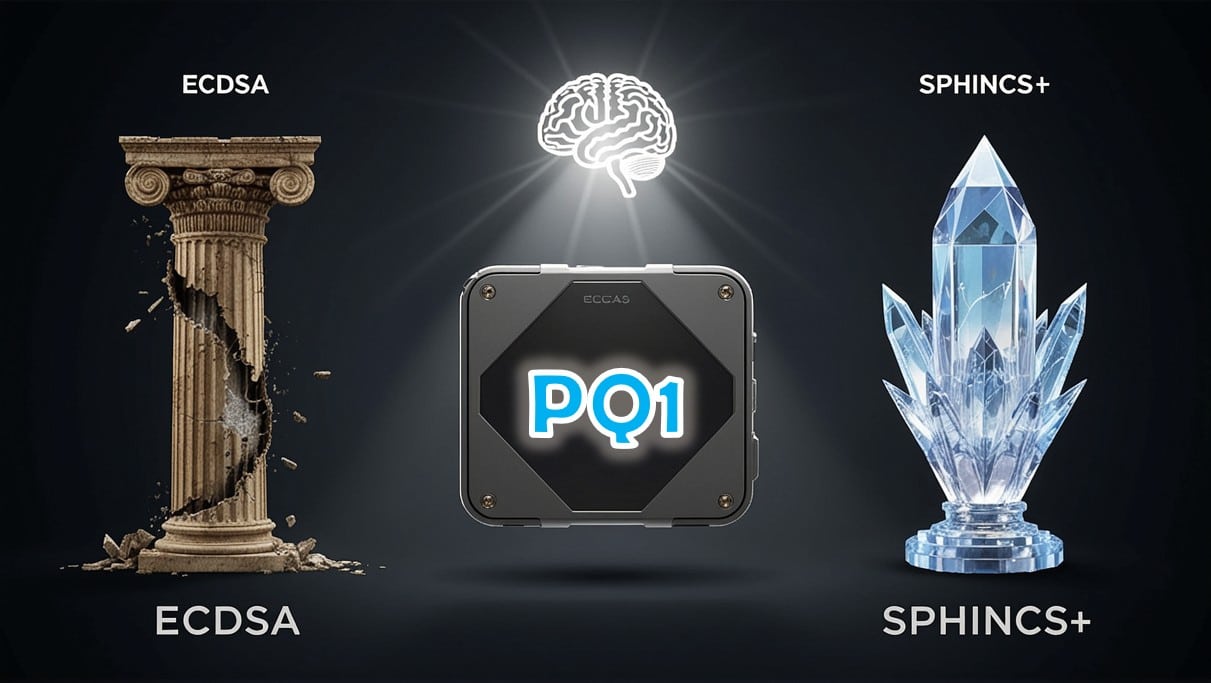
The PQ1’s security proposition is a complete break from the past… it completely forgoes the ECDSA cryptographic standard that underpins nearly all modern crypto wallets, a standard known to be vulnerable to future quantum attacks.
Instead, it uses SPHINCS+C10, a NIST-approved post-quantum signature algorithm.
This is a fundamental shift from relying on computational difficulty to relying on mathematical proofs that remain secure even against a quantum adversary.
The hardware itself is beefed up with dual EAL6+ secure elements… a step above the industry standard & employs seed XOR-splitting… meaning your recovery seed is divided between the two chips, eliminating a single point of failure.
On paper, this is one of the most robust hardware architectures ever brought to market.
An Ethereum Wallet Built for the Future
The PQ1 is not trying to be everything to everyone.
Its initial focus is laser-targeted on the Ethereum ecosystem and EVM-compatible chains.
This is a strategic choice.
As I’ve covered previously, Ethereum’s developers are already laying the groundwork for a post-quantum future.
Lean Ethereum proposals are actively exploring how to transition away from vulnerable cryptography… making a wallet that is ready for that shift, not just novel… but necessary.
By leveraging ERC-4337 for account abstraction, the PQ1 is building for an Ethereum of tomorrow… one that includes advanced features like social recovery.
However, this focus leaves Bitcoin users in the cold, as the device does not support ECDSA-based chains. This is a critical limitation for the largest asset by market cap, and likely top of mind for many Bitcoiners given the recent ColdCard breach.
Trusting AI to Guard Your Keys

But the innovations coming from the PQ1 don’t end with the signature algorithms…
The PQ1 ventures into uncharted territory as the Freedom Factory has made the device’s firmware fully open-source and is actively encouraging users to verify its integrity using AI models like ChatGPT or Claude.
The idea is to democratize security audits… allowing anyone to ask an AI to scan the code for backdoors, vulnerabilities, or unexpected behavior.
It’s a fascinating concept that puts the power of verification in the hands of the user, but it’s also fraught with risk.
Can we rely on an AI, which can be prone to “hallucinations” or manipulation, as the final arbiter of your financial security?
It replaces the “trust me” of a closed-source company with a “trust the AI” model… a trade-off that every potential user must weigh for themselves.
Toshi Solution: A Bridge for Bitcoin
Recognizing that a quantum-resistant future must include Bitcoin… Freedom Factory is already developing a second version… the Toshi PQ1.
This model will use a different post-quantum algorithm, ML-DSA-65, which leverages on-device machine learning to manage the larger, more complex signatures.
This is a crucial acknowledgment that one size does not fit all in a post-quantum world… and demonstrates a commitment to securing the entire ecosystem.
The Clear Signing Advantage
One of the most practical and compelling features the PQ1 brings to the table is its commitment to “clear signing”.
In a previous HODL The Line episode we discussed the dangers of “blind signing.”
We exposed how users routinely approve transactions they cannot fully read, making them vulnerable to phishing and approval scams.
The PQ1 addresses this head-on by decoding transaction data directly on the device.
This means you can see exactly what you are signing in plain English… for over 17,000 tokens… eliminating the ambiguity that plagues other wallets.
This feature, while less flashy than quantum resistance or AI verification, provides immediate, tangible security benefits for every single user… every single day.
The Quantum Question
The Freedom Factory PQ1 is one of the most ambitious and thought-provoking hardware products to hit the market in years.
It successfully combines cutting-edge post-quantum cryptography… a forward-looking Ethereum-centric design… and the incredibly practical clear signing feature.
Its reliance on AI verification is a bold experiment in transparency that could either revolutionize trust or become its greatest point of failure.
With the Toshi PQ1 already in development to cover Bitcoin, it’s clear this is a serious attempt to build the future of self-custody.
Whether it becomes the new gold standard or a noble footnote… the PQ1 has forced the entire industry to have a much more serious conversation about what security will mean in the age of quantum computing.
Join The Discussion on HODL The Line
Disclaimer
The information provided here is for INFORMATIONAL & EDUCATIONAL PURPOSES ONLY!
View our complete disclaimer on our Disclaimer Page