Security Alert: Your Coldcard Wallet May Be Compromised
Last updated on August 15th, 2026 at 05:57 am
What’s worse than a thief who breaks into your vault?
A thief who was handed the key.
That’s the reality for thousands of Bitcoin holders who trusted their savings to Coinkite’s Coldcard hardware wallets.
A “days-long” active attack has exploited a catastrophic bug in the device’s firmware, one that made the creation of new wallet seeds predictable.
While Coinkite urges users to migrate, it is declining to estimate the amount of Bitcoin already lost, leaving victims in the dark.
This isn’t just a failure of code… it’s a crisis of trust and a brutal lesson in the true meaning of self-custody.
Randomness Became a Recipe for Disaster
For anyone who uses a hardware wallet to secure their crypto assets, this story with Coldcard is a chilling reminder that even the most trusted tools can have catastrophic flaws.
At the very heart of the disaster with Coldcard is its Random Number Generator (RNG), the engine responsible for creating the secure seed phrase that protects your funds.
According to a detailed analysis by Block’s security team, a critical software bug in the Coldcard firmware caused the device to bypass its own secure hardware RNG.
Instead, it defaulted to a deterministic, software-based “fallback” generator.
This fallback was initialized using highly predictable values like the device’s unique ID (UID) and simple timer registers.
This means that for certain devices and firmware versions, the “randomness” used to generate your wallet’s master key was not random at all… it was a calculable sequence… turning the sacred act of creating a new wallet into a predictable, exploitable process.
What Is a Random Number Generator?
I don’t know about you, but prior to entering the crypto space, I had never even heard of a Random Number Generator (RNG).
So, for any of you who are like me… let me try to break it down for you…
You can think of a Random Number Generator (RNG) as the digital equivalent of rolling a perfect, untampered die… its only job is to produce a result that is completely unpredictable and has no pattern.
In the world of crypto wallets, your seed phrase isn’t just “random”… it’s the direct output of an incredibly long sequence of these “dice rolls.”
To create your seed phrase, the wallet’s RNG generates a massive, unique number, which is then converted into those words you ultimately write down and place in secure locations… right?
Learn more about securing your seed phrase here.
If the die is loaded or the process is predictable… an attacker can figure out the sequence of “rolls,” recreate your number, and steal your entire wallet.
Here’s another way to picture a Random Number Generator… think of it just like shuffling a new deck of cards… a perfect shuffle creates a completely random order that no one can predict.
But what if the shuffler was lazy and only did a perfect “bridge shuffle,” putting the red cards on top and the black on the bottom every time?
If you knew that pattern… you could guess every card.
Your wallet’s RNG has to be a perfect, unpredictable shuffle every single time to keep your funds safe… your entire crypto kingdom rests entirely on true, unbreakable randomness.
Models & Firmware Versions Affected
If there is any “good news” in this story, it’s that not every Coldcard user is affected.
The vulnerability is specific to the firmware version used at the exact moment the seed was generated.
If you generated your seed on an affected device, your funds are at risk, regardless of whether you’ve updated the firmware since.
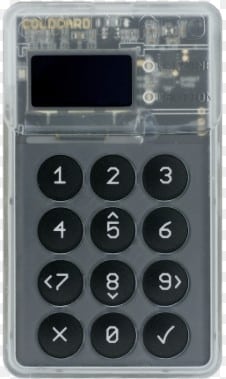
The confirmed impacted devices are:
* Coldcard Mk2 and Mk3: Firmware versions 4.0.1 through 4.1.9 are critically compromised, with seed entropy reduced to a dangerously low ~40 bits.
Some reports place the vulnerable range even wider, up to 5.0.3, but Coinkite’s official advisory is the most precise.
* Coldcard Mk4, Mk5, and Q: All production firmware before their respective fixed versions (Mk4/Mk5 standard v5.6.0, Q standard v1.5.0Q, etc.) is also affected, though less severely.
Seeds generated on these devices have approximately 72 bits of entropy instead of the expected 128 bits, which is still a serious security weakness.
If your device was used to generate a seed on this firmware… it is compromised.
Upgrading your firmware today does not fix a seed that was created in the past.
Why ColdCard Wallet Was an Easy Target
Ultimately, what makes this issue with ColdCard so bad is that it doesn’t take a “Lazarus Group” level hacker to exploit this flaw…
The predictable nature of the RNG means an attacker, who could determine or even approximate a device’s UID… and boot timing… could reproduce the entire sequence of “random” numbers offline.
They could then generate a list of possible seeds and check them against the blockchain.
Every time you receive a transaction or generate a new address, you provide a public key that serves as a confirmation oracle for an attacker trying to guess your seed.
Think of it like this… imagine an attacker is trying to guess the secret combination to a giant vault, but they don’t know if their guesses are correct.
However, every time you open the vault to put something new inside, a tiny light on the outside flashes in a specific, predictable way.
An attacker watching that light doesn’t need the whole combination… they can just keep guessing until they see the right flash… confirming they’ve found the correct sequence to open your vault.
In the same way, every public key you create gives an attacker a tiny, verifiable clue that they can use to confirm their guesses and work backward toward your private seed.
So in the case of the older ColdCard Mk2/Mk3 devices… the process was entirely deterministic… making the search space trivially small.
For newer devices, while a 32-bit input from the secure element was added, it was so small that it only reduced the search space to a number that is computationally trivial for a dedicated attacker to crack.
Coinkite’s Unacceptable Response
Perhaps as alarming as the bug itself is the company’s response.
In a statement to Bloomberg, Coinkite confirmed the “days-long attack” but declined to estimate the amount of customer losses, stating it was “heads down helping affected customers.
In my opinion… this is a profound failure of transparency… don’t users have the right to know the scale of the catastrophe?
By withholding this information, Coinkite is preventing its user base from accurately assessing their own risk and making informed decisions… it erodes the very trust that is the bedrock of the self-custody model.
Final Word on Security: You
The Coldcard vulnerability is a watershed moment for the hardware wallet industry.
It’s a stark reminder that “cold storage” is not magic… it’s technology… and all technology can fail.
The predictable RNG bug wasn’t a subtle flaw… it was a catastrophic breakdown in the most critical function of a wallet… creating a secure key.
Coinkite’s failure to be transparent about the resulting losses compounds the damage.
This incident serves as the ultimate lesson in self-custody… you must always remain vigilant… understand the technology you rely on… and never trust blindly.
The responsibility for your security was always yours… now more than ever.
Join The Discussion on HODL The Line
Disclaimer
The information provided here is for INFORMATIONAL & EDUCATIONAL PURPOSES ONLY!
View our complete disclaimer on our Disclaimer Page