Quantum Computing Forces a Reckoning for Cryptocurrency Security
If you’re on X, then you’ve undoubtedly seen all of the recent posts and videos about quantum breaking Bitcoin any day now…
And, if I’m being honest… the quantum timeline has definitely shrunk given some recent advancements.
So, for some, the theoretical threat of quantum computing unraveling modern cryptography has suddenly become an urgent reality.
With recent breakthroughs from institutions like Google, D-Wave, and Fermilab have dramatically shortened the timeline for when quantum machines could feasibly break the encryption securing Bitcoin and other digital assets.
Then, combine this with analyses from corporate research papers and peer-reviewed journals indicate that the foundational assumptions of crypto security are crumbling faster than anticipated… forcing a race against time to develop and deploy quantum-resistant safeguards…
Frankly as I read those words, I hear thematic music in the background… it’s like the beginning of a thriller movie…
But, these things are real… the timelines are shortening… and crypto is one of the areas vulnerable to quantum… but so is everything else!
Drastic Reduction in Required Resources
Look… the truth is that the consensus from multiple fronts signals a paradigm shift.
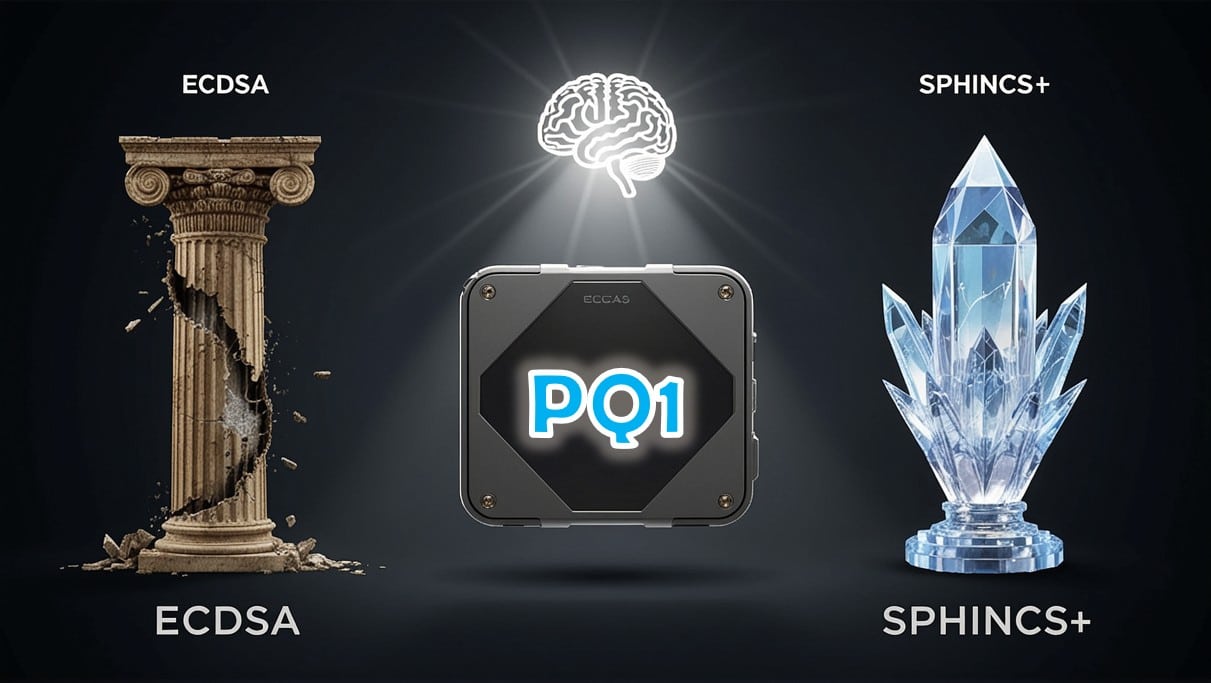
In a landmark Google white paper it was determined that breaking Bitcoin’s Elliptic Curve Digital Signature Algorithm (ECDSA) would require approximately 500,000 physical qubits…
I know… I know… what’s a qubit?
How To Think About Quibits
So let me try to explain without hurting your head… and frankly my head too much…
For the younger (than me) generation… imagine you’re playing a video game, and you reach a crossroads.
You can either go LEFT or RIGHT.
That choice is how a regular computer works… it deals with bits… which are strictly one thing OR the other.
A bit is either a 0 (LEFT) or a 1 (RIGHT).
A qubit… which is what powers a quantum computer… is completely different.
So, at that same crossroads… a qubit doesn’t choose left or right… instead, it spins in a dizzying circle, existing as BOTH left and right AT THE SAME TIME.
It holds the possibility of every path, until you finally poke it, and force it to commit to one.
Now, while I would like to think that I’m intelligent enough to completely wrap my head around that example… I am definitely no gamer…
Traditional Computers (Bits)
So, us old folks reading this… let’s try this example…
Imagine the process of finding a lost set of keys in our crypto mansion… you have one of those, right?

If we were a regular computer… let’s call ourselves “Mr. Bits”… this is how searching our mansion would go down…
Our mansion has 10,000 rooms (we would need multiple maids… err… sorry… getting off track)
As a regular computer, Mr. Bits would have to act like a methodical security guard… go into Room 1, check for the key… then Room 2, check for the key… then Room 3… hopefully you get the idea…
The bottom line for Mr. Bits is he would have to search each room, one by one, in order… this could take ages…
Quantum Computer (Qubits)
Now, if we were a quantum computer… let’s call ourselves “Mr. Quibts”… this is how searching our mansion would go down…
A quantum computer acts differently to find our keys…
Why?
Because Mr. Qubits can be in multiple states at once… so it’s like having clones of yourself appear in EVERY SINGLE ROOM of the mansion SIMULTANEOUSLY.
I know… it sounds a bit scifi to me too… but bare with me…
So there would be 10,000 versions of Mr. Qubits checking for the key at the exact same time… and the instant one clone finds them… the entire operation stops, and you instantly know where the key is.
I hope those examples help you to understand what qubits are.
So, let’s translate this into doing something like searching a massive database… or breaking a code (which is essentially guessing the right key among trillions of possibilities)… that simultaneous checking ability gives a quantum computer an unimaginable edge… and makes a quantum computer an incredibly powerful option for solving certain kinds of puzzles.
So, if we go back to where this conversation started… breaking Bitcoin… you can see why these break throughs, which have produced a staggering 80-95% reduction in necessary qubits, is concerning.
Convergence Creates Exponential Growth
Three key engineering feats in the last few months have catalyzed this acceleration.
Sleek & Self Contained
At its core… D-Wave achieved scalable on-chip cryogenic controls, solving the resource-intensive bottleneck of adding qubits.
Prior to this breakthrough…every time engineers wanted to add more qubits (the brains of the operation we just discussed), they needed to install an equal amount of extra, bulky equipment… miles of delicate wiring… complex cooling pipes… and more physical space.
It was like trying to upgrade a laptop by constantly bolting on bigger, heavier power generators… they became impractically enormous.
D-Wave found a way to miniaturize the control system. They integrated sophisticated electronic controllers directly onto the microchip alongside the qubits themselves.
Essentially, they swapped a messy, room-sized tangle of cables for a sleek, self-contained unit.
Quiet The Noise
But the recent innovations don’t end there…
Spanish researchers unlocked stable Majorana qubits with millisecond-scale coherence, addressing the persistent error-correction challenge.
I know… I know… another word salad…
So, let’s try to explain what this means using an analogy…
Imagine you’re trying to whisper the following secret message… “meet at noon”… across a crowded, loud stadium.
With old qubits… I know… we literally just learned what qubits are, and they’re already outdated…
Anyway… with old qubits… it’s the equivalent of whispering in a hurricane…
Traditional qubits are incredibly fragile… trying to hold a piece of information in them is like trying to hold that whispered message in your mind.
Immediately after you hear the message, the roar of the crowd (background heat, vibrations, radiation) drowns it out.
The message becomes garbled nonsense almost instantly… this is the “error” problem… losing the information before you can even use it.
Enter new qubits… The Majorana Qubits…
Basically researchers engineered this special type of qubit to behave differently.
The way it stores information isn’t like whispering… it’s like carving your message into a solid stone tablet.
Even amidst the deafening chaos of the stadium… the carved message remains perfectly intact and readable.
Furthermore, these researchers have achieved millisecond-scale coherence which means that this “stone tablet” holds its message for milliseconds.
And while that might sound tiny… in the ultra-fast world of quantum computing… it’s an eternity… it’s the equivalent of not just quieting the crowd slightly… it’s a complete reinvention of the way to record the message that makes the crowd irrelevant.
Perfect Synchronization
But wait, the innovations don’t end there…
Because, Fermilab and MIT developed a new ion-trapping architecture capable of scaling to millions of qubits.
I know… right now you are saying… “so what the heck does this mean?”
Let me try to explain using another analogy…
Imagine you want to organize a massive dance troupe with a million performers…
Your goal is to teach them a perfectly synchronized routine.
The classic approach is to build one gigantic stage and cram all one million dancers onto it… it’s a logistical nightmare.
You need colossal speakers for music… impossible rigging for lights… and it’s nearly impossible to give instructions to individuals without disturbing everyone else.
Scaling this up gets harder… and crazier… with every dancer you add.
But this new Ion-Trapping Architecture is like having millions of mini-stages.
Instead of one giant stage, Fermilab and MIT pioneered a blueprint for giving each performer their own miniature, high-tech dressing room… and inside each room… you have a tiny speaker, and a small spotlight built-in.
Now, you can coordinate groups of rooms… then clusters of groups… linking them all together electronically.
Why This Changes Everything
I realize that was all a bit technical…
I usually try to keep things a bit ‘lighter’ than all that… but it was necessary to help you wrap your head around what is incoming with quantum.
So, picking up where we left off…
This modular approach is genius… because organizing one thousand mini-stages… it’s predictable and manageable… organizing ten thousand then becomes just repeating the same proven process.
You aren’t fighting physics… you’re copying a successful design.
This new architecture is the instruction manual for building a quantum computer… a quantum computer that can finally expand from a handful of qubits… to the millions needed to tackle truly monumental problems.

It turns a chaotic free-for-all into a replicable assembly line.
The result?
This simultaneous progress in hardware stability and architectural design creates a feedback loop, propelling capabilities forward at an unprecedented rate.
Crypto Is Ground Zero, But Not the Only Target
So, let’s bring this back around to crypto…
While Bitcoin often dominates the discourse within the crypto space…the threat extends universally to all systems reliant on standard asymmetric cryptography.
However, blockchain networks face a unique… and acute pressure.
[ccpw id=”9203″]
Unlike centralized systems that can mandate updates… distributed ledgers like Bitcoin require slow-moving… often contentious forks… to implement quantum-resistant fixes.
Although developers are exploring upgrades like BIP-360… the contrast remains stark.
While Ethereum actively targets a 2029 deadline for quantum resistance… Bitcoin’s conservative approach leaves it more exposed in the medium term.
This is something discussed by BC PortCorp and myself during a recent episode of HODL The Line.
Check It Out
A Look To The Future
I think we can say with confidence; that the era of treating quantum computing as a distant menace is unequivocally over.
The convergence of tangible hardware breakthroughs and newly discovered mathematical efficiencies has compressed the threat horizon from decades to mere years.
While the eventual compromise of SHA-256 is not guaranteed, the probability has increased significantly.
The focus must now pivot from debate to preparation, prioritizing the development of agile defense mechanisms and ensuring that the architects of our financial systems are not left reacting to a crisis they failed to anticipate.
Disclaimer
The information provided here is for INFORMATIONAL & EDUCATIONAL PURPOSES ONLY!
View our complete disclaimer on our Disclaimer Page